The Great Migration is often pictured as one dramatic river crossing, but the real story is much bigger. Wildebeest are moving through the Serengeti and Maasai Mara ecosystem all year, following rain, fresh grass, and water in a broad circular pattern that repeats with the seasons.
That is why a migration calendar matters so much when planning a safari. It helps answer the question most travelers ask first: where are the wildebeest likely to be when I visit? The key word is likely, because this movement is shaped by weather, and weather does not follow a fixed script.
A simple way to think about the cycle is this:
- southern plains and calving season
- central Serengeti movement
- western corridor and Grumeti crossings
- northern Serengeti and Mara River crossings
- southbound return with the short rains
How the Great Migration calendar works in the Serengeti and Maasai Mara
More than 1.5 million wildebeest, joined by hundreds of thousands of zebra and gazelle, move through the Serengeti-Mara ecosystem in one of the planet’s great wildlife cycles, demonstrating intricate animal migration patterns. This is not a straight-line trip from point A to point B. It is a continuous loop shaped mainly by rainfall, the growth of nutrient-rich grass, and can be experienced in various ways, such as on a 2-day Kruger safari.
The herds gather on the short-grass plains of the southern Serengeti after the short rains, usually from late November into the first months of the year. This is where calving takes place, especially around Ndutu and the southeastern plains. As the season changes and the southern grass begins to dry, the animals spread west and north through central Serengeti and the western corridor, often monitored by mobile camps that provide flexible accommodations for following the herds.
By mid-year, many herds push toward the Grumeti and then farther north to the Mara River. In late dry season, they are often found in northern Serengeti and the Maasai Mara. When the short rains return in Tanzania, the cycle bends south again.
That pattern is reliable in broad terms, but the exact timing can shift by days or even weeks. A year with early rain may keep herds in one area longer. A drier year may move them on faster. This variability makes the 2026 migration particularly exciting, as even slight shifts can produce unique wildlife moments.
Great Migration calendar by month
If you want a practical month-by-month guide, this 2026 wildlife calendar provides the clearest starting point.
| Month | Typical wildebeest location | Main wildlife event | What travelers can expect |
|---|---|---|---|
| January | Southern Serengeti, Ndutu, Ngorongoro Conservation Area edge | Calving begins and builds | Huge herds on open plains, strong predator activity |
| February | Southern Serengeti and Ndutu plains | Peak calving season | Newborn calves, cheetahs, lions, hyenas, excellent action |
| March | Southern to central Serengeti | Calving tapers, herds begin shifting | Green landscapes, moving columns, changing herd positions |
| April | Central Serengeti and western route | Long rains, steady movement | Lush scenery, fewer vehicles, possible muddy roads |
| May | Western Serengeti and Grumeti area | Herds mass in long lines | Strong migration scenes, building river activity |
| June | Western corridor to northern Serengeti | Grumeti crossings and rutting | Movement north, dramatic behavior, dry season starts |
| July | Northern Serengeti | Mara River approach and crossings begin | Riverbank build-up, crossing drama possible |
| August | Northern Serengeti and Maasai Mara | Peak Mara River action | Iconic crossings, heavy safari demand; 2026 visitors are already buzzing about these dramatic scenes |
| September | Maasai Mara and northern Serengeti | Grazing in the north, some crossings continue | Great all-round game viewing; 2026 forecasts hint at continued impressive wildlife displays |
| October | Maasai Mara and northern Serengeti | Herds begin turning south | Fewer crossing scenes, strong predator sightings |
| November | Central Serengeti | Southbound return after short rains | Fresh green growth, moving herds, quieter season |
| December | Southern Serengeti and Ndutu | Return to calving grounds | Herds regroup in the south, calving cycle about to restart; a promising end to the 2026 migration cycle |
Even this table should be used as a guide, not a promise. Some travelers arrive in “crossing season” and do not see a crossing on cue. Others visit in a shoulder month and catch unforgettable movement because the rains lined up just right.
January to March migration in the southern Serengeti
The first part of the year is all about the southern plains. Around Ndutu, the southeastern Serengeti, and the edge of the Ngorongoro Conservation Area, the herds gather on short, mineral-rich grass that supports mothers and newborn calves.
February is often the headline month because the calving peak can be extraordinary. Vast numbers of calves are born within a short period, which means the plains are full of life and constant movement. Predators know this. Lions, hyenas, cheetahs, and jackals are never far away, making this one of the best times for travelers who want raw predator-prey interaction. For those planning safaris in 2026, this season offers a vibrant display of natural vigor and renewal.
It is also one of the most rewarding seasons for photographers. The landscapes are green, the skies can be dramatic, and the sheer density of animals is hard to match elsewhere on the circuit.
April to June migration in central and western Serengeti
As the herds begin to leave the south, they stretch into central Serengeti and then into the western corridor. April and May are linked to the long rains, so the scenery can be lush and beautiful, but road conditions can be slower and some safari styles work better than others.
This is a good period for travelers who care less about one single famous moment and more about the feeling of migration itself. Long files of wildebeest can cover the plains, often with zebra mixed in, all moving with purpose.
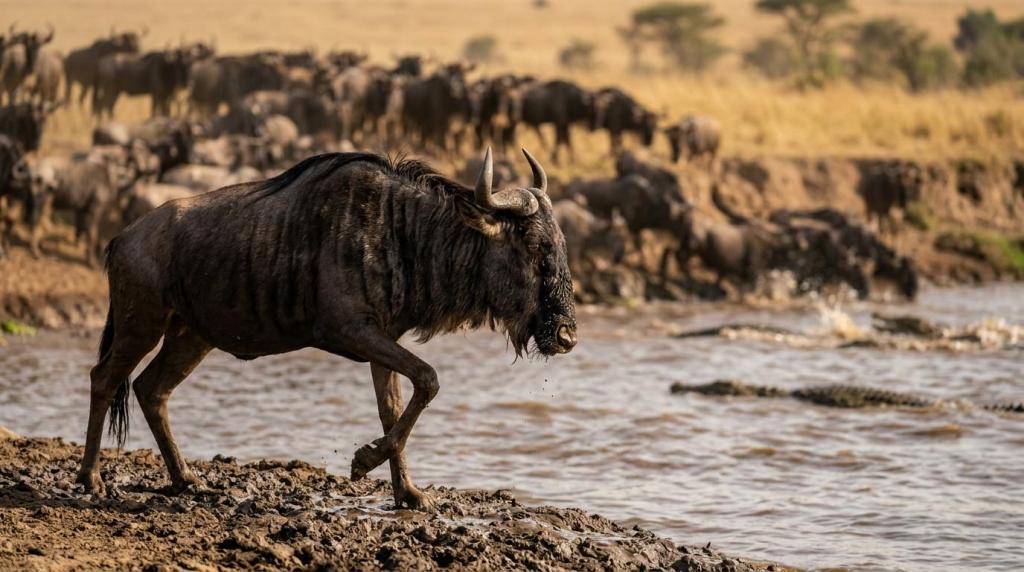
By late May and June, attention shifts toward the western Serengeti and the Grumeti area. The crossings here are less famous than the Mara River scenes, yet they can still be very dramatic. Crocodiles wait in the water, and the pressure of the herd builds at crossing points. Travelers heading out in 2026 might find these less-crowded routes particularly appealing.
This stage also includes rutting behavior in June, when males become more active and confrontational.
A few planning points help in this season:
- Best for: moving herds, green scenery, fewer crowds than peak dry season
- Watch for: wet roads and slower travel in April and parts of May
- Good timing: late May into June for western corridor movement and Grumeti action
July to October migration in northern Serengeti and Maasai Mara
This is the period most travelers think of first, and with good reason. From July onward, many herds reach the northern Serengeti and begin gathering near the Mara River. Some cross quickly. Others hesitate, bunch up, turn away, and come back again.
That uncertainty is part of what makes the spectacle so intense. A crossing is never scheduled. You may wait beside a riverbank as the herd mills around for an hour, then suddenly thousands plunge into the water at once. Or the herd may decide not to cross at all. Good guiding makes a real difference here, because current herd position, fresh tracks, and recent rain all shape the odds of being in the right area at the right time.
August is often seen as peak crossing month, especially in the northern Serengeti and Maasai Mara. September can still be excellent, with some crossings continuing and very strong predator sightings on the surrounding grasslands. By October, many animals remain in the north, though the broader movement starts to angle south as conditions change. Visitors planning 2026 trips should be prepared for the drama of nature, even if the exact timing cannot be predicted. If you are planning to witness the dramatic river crossings during these months, booking a 3 Day Masai Mara Safari from Nairobi will place you right in the heart of the action.
November to December migration return to the south
When the short rains begin in Tanzania, the system changes again. Fresh grass appears in central and southern areas, and the herds start the return leg through central Serengeti.
November is sometimes overlooked, yet it can be rewarding. Visitor numbers are often lower, the plains begin to green up, and the migration feels fluid and active rather than concentrated around one famous crossing point.
By December, many herds are back in the southern Serengeti and Ndutu region. The cycle is resetting. Calving is close, the grass is fresh, and the stage is ready for another season of births and predator action. This year, as with 2026’s trends, the return phase signals a period of calm after the dramatic mid-year journeys.
Best Great Migration months for different safari goals
The best month depends less on a universal “best time” and more on what you most want to see. A traveler dreaming of newborn calves should not choose the same window as someone focused on Mara River crossings.
Here is a practical way to match travel dates with safari goals:
- Calving and predator action: January through March, especially Ndutu and the southern Serengeti
- Classic river crossing drama: July through September in northern Serengeti, with August often in highest demand
- Fewer vehicles with strong migration scenes: April to June in central and western Serengeti, or November during the southbound return
- All-around northern game viewing: September to October in the Maasai Mara and northern Serengeti
For travelers charting their journeys in 2026, splitting a safari across regions often brings the most balanced experience. A southern plains and central Serengeti route in February offers a very different feel from a northern Serengeti and Mara-focused trip in August.
How to plan a safari using the Great Migration calendar
The smartest way to use a migration calendar is to treat it as a planning tool, not a guarantee. Nature is consistent in pattern, but flexible in timing. That means your itinerary should be built around the season’s likely hotspots, with enough room to adjust based on recent rain and herd reports. This approach is especially useful for those planning adventures in 2026, when slight seasonal variations can make a big difference in wildlife encounters.
Booking early matters most for northern Serengeti and Maasai Mara travel in peak crossing season. Camps close to the river are limited, and the best-located options can fill far in advance. The same applies to popular calving-season stays in the Ndutu area.
A few basics make planning easier:
- flexible dates
- the right region for the season
- realistic expectations
- a guide team that tracks current movement
- enough nights in one area to wait for wildlife action
Length of stay matters more than many first-time travelers expect. A three-night northern Serengeti stay gives you a much better chance of seeing meaningful movement than a rushed one-night stop. The same is true in Ndutu during calving season. Wildlife moments often come to those who can give the herds time.
It also helps to think beyond wildebeest alone. Every stage of the migration brings excellent wildlife. Calving season means cats on the plains. The western corridor brings huge columns of grazers and river tension. The north offers crossings, crocodiles, and dense predator populations. Even when the exact herd position shifts, the ecosystem remains busy and rewarding.
A well-planned safari does not chase a single image. It matches the season, the region, and the traveler’s goals, then leaves space for the natural rhythm of the Serengeti and Maasai Mara to do the rest. With thoughtful planning—whether it’s for an adventure in 2026 or beyond—you can expect an unforgettable journey into one of nature’s most spectacular events.