
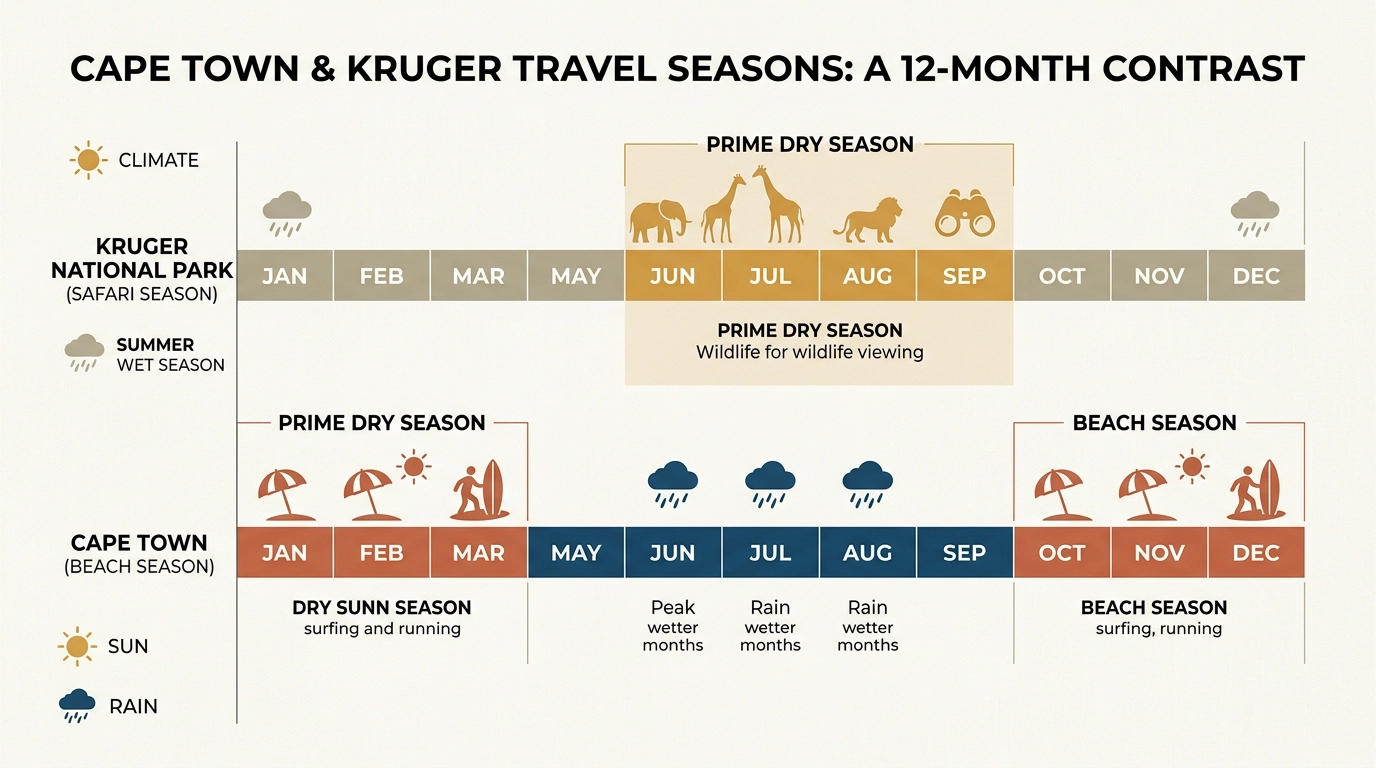
The best time to visit South Africa is generally May–September for Kruger wildlife visibility and November–March for Cape Town’s warmer, drier beach season. A combined holiday needs a regional compromise.
Best months for your trip
Cape Town and Kruger have contrasting rainfall patterns, so choose dates around the experience you most want. June–August brings generally dry safari conditions to Kruger but wetter winter weather to Cape Town. December–February reverses that balance.
South Africa’s seasons are opposite those in the US and UK. If wildlife drives are your priority, build around Kruger’s dry season. For Cape beaches, favor summer and expect greener, rainier safari conditions if you add Kruger. Neither choice delivers ideal weather everywhere.
South Africa weather by month
South Africa’s monthly weather needs a regional comparison: Cape Town receives winter rain, while Kruger usually receives summer rain. Skukuza, shown below, is a station in southern Kruger.
Temperatures are average daily maxima and minima from the historical 1961–1990 period. They are not forecasts, contemporary climate normals, or the limits of temperatures you could encounter.
| Month | Cape Town max/min °C | Skukuza max/min °C | Regional conditions and trip focus |
|---|---|---|---|
| January | 26.1/15.7 | 32.6/20.6 | Cape Town is generally sunny and mostly dry, with busy beaches and possible wind. Kruger is hot and rainy; plan for summer safari conditions. |
| February | 26.5/15.6 | 32.0/20.4 | Generally dry Cape weather favors beach days and outdoor sightseeing. Kruger’s greener vegetation can obscure animals, although the summer scenery offers a different safari experience. |
| March | 25.4/14.2 | 31.2/19.1 | Cape Town moves into autumn, with outdoor sightseeing still attractive. Kruger remains within its usual hot, rainy season rather than entering a reliably dry window. |
| April | 23.0/11.9 | 29.4/15.4 | Rain becomes more likely in Cape Town as Kruger moves toward drier conditions. Easter can make particular dates busy, so compare your intended travel days. |
| May | 20.3/9.4 | 27.9/10.0 | Cape Town becomes cooler and wetter. Kruger enters the generally favorable May–September wildlife-viewing window, with warm days but a growing need for layers after dark. |
| June | 18.1/7.8 | 25.9/5.6 | Cape Town is in its wet winter period. Kruger generally offers dry conditions, but early game drives can feel cold despite the warmer daytime temperatures. |
| July | 17.5/7.0 | 25.9/5.7 | Cape Town suits food, cultural visits, and flexible outdoor plans between wet spells. Kruger has established dry-season conditions, with cold mornings and generally clearer wildlife visibility. |
| August | 17.8/7.5 | 27.3/8.7 | Cape winter continues, while seasonal whale and wildflower outings broaden the options. Kruger generally retains favorable dry-season visibility as daytime temperatures begin to rise. |
| September | 19.2/8.7 | 29.3/12.8 | Cape spring remains changeable rather than reliably beach-ready. Kruger stays within its usual dry season, making September a useful choice for a safari-led regional combination. |
| October | 21.3/10.6 | 29.8/16.0 | Cape Town becomes progressively drier. Kruger enters its usual rainy season, although rainfall onset varies and vegetation does not change on a fixed calendar date. |
| November | 23.5/13.2 | 30.6/18.1 | Warmer, generally drier Cape conditions favor coastal plans. Increasing rain and vegetation growth change Kruger’s viewing conditions, with a growing contrast between the two regions. |
| December | 24.9/14.9 | 31.9/19.7 | Cape summer holidays bring stronger demand for accommodation and transport. Kruger is generally hot and rainy, so expect greener surroundings rather than dry-season viewing conditions. |
Climate data: World Meteorological Organization and SANParks Scientific Services. Seasonal guidance: Cape Town Tourism and SANParks.
Even within Kruger, location matters: June’s historical average minimum is 5.6°C at Skukuza, compared with 8.6°C in the park-wide figures. One temperature range cannot describe every camp.
Regional seasons and wildlife highlights
August–September can combine Kruger’s dry-season safari conditions with Cape whale and wildflower outings, although each experience remains weather-dependent.
Cape Town and coastal journeys
Cape Town’s summer favors beaches; winter leaves room for food, culture, and city visits between wet spells. Summer wind can also disrupt outdoor plans.
The Garden Route generally runs from Mossel Bay to Storms River, following South African Tourism’s route description. Cape Town can start a longer journey, but its climate does not describe the whole route. SANParks identifies temperate conditions and year-round rainfall in Wilderness, Knysna, and Tsitsikamma.
Hermanus tourism places southern-right whale arrivals around June or July, continuing until approximately mid-November, with generally strong viewing in August–September. West Coast National Park’s flowers generally appear in August–September, but timing and abundance depend on preceding winter rainfall.
Kruger visibility and summer birding
Kruger’s dry season generally makes animals easier to see as vegetation thins and water concentrates around rivers and waterholes. Favorable visibility never guarantees sightings.
Summer has a different advantage: returning migrant birds increase the variety of species present, as SANParks’ birdwatching guidance explains. Bird-focused travelers may prefer that seasonal variety over clearer mammal viewing.
Booking, packing, and health essentials
Cape Town’s festive season needs advance planning, while Kruger requires warm layers and travel-health preparation even for winter visits.
South African Tourism identifies mid-December to mid-January as especially popular. Reserve accommodation and transport ahead if those dates are fixed.
Pack waterproof layers for Cape winter and Garden Route travel. Add warm clothing for early and evening Kruger drives, even when the forecast promises warm afternoons.
Kruger has malaria risk. Use mosquito-bite prevention throughout the year and seek individualized advice from a qualified travel-health professional in every season.
The CDC Yellow Book 2026 recommends preventive medication year-round for relevant risk areas. UK guidance from TravelHealthPro takes a seasonal approach; medication decisions belong with a clinician. Winter should never be treated as malaria-free.
Arrange a travel-health appointment ideally four to six weeks before departure. Advice remains worthwhile for shorter-notice trips.
South Africa travel FAQs
South Africa’s seasonal patterns help narrow your dates, but price and excursion availability still need itinerary-specific checks.
Is winter always the cheapest season?
No. Cape Town’s cooler months can offer better value, and South African Tourism associates summer demand with higher accommodation and flight costs. Holidays and events create exceptions.
Cape Town’s pattern does not establish the cheapest season for Kruger or South Africa nationally. Compare accommodation and transport quotes for your route and dates.
Can weather cancel whale-watching trips?
Yes. Hermanus tourism identifies boat departures as weather-dependent. Traveling during whale season guarantees neither a sailing nor a sighting.
Plan your seasonal South Africa trip
Africa Moja Tours and Safaris can build your itinerary around the experience that matters most to you.
Our 3-Day Kruger Safari from Johannesburg lasts three days and two nights, with afternoon, full-day, and morning safari outings across the itinerary. Our 6-Day Cape Town and Garden Route Explorer lasts six days and five nights, with private and small-group options and stops adjustable around your interests.
Request a tailored itinerary from Africa Moja Tours and Safaris. Share your travel dates, budget, and priority experience, such as dry-season wildlife viewing, Cape beaches, whales, or birding, so we can match your regional route to the season.