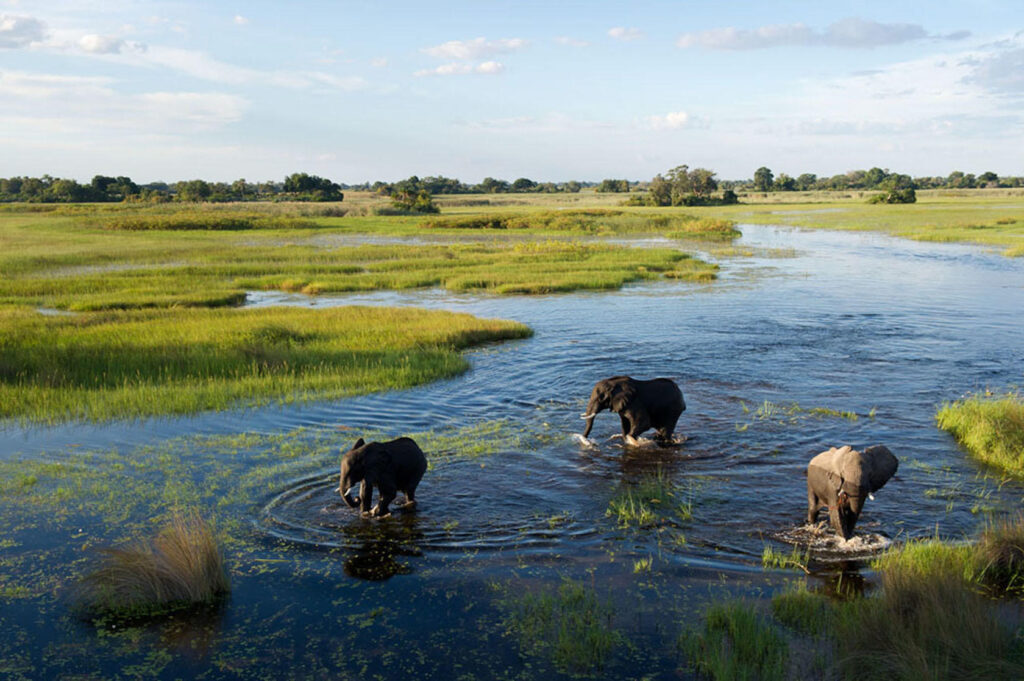
The Okavango Delta is not a river that reaches the sea. It is a river that gives up, spreads out, and turns into 15,000 square kilometers of channels, lagoons, and islands in the middle of the Kalahari Desert — and that strange, unfinished geography is exactly why it holds one of the densest concentrations of wildlife on the continent. If you are planning African safari tours and want something that stands apart from a standard game drive, a Botswana Okavango Delta safari belongs at the top of your list.
At Africa Moja Tours, we build Okavango Delta safari packages from both Johannesburg and Cape Town, and this guide covers what makes the Delta different, when to go, what you’ll see, and how to fit it into a wider Southern Africa itinerary.
What Makes the Okavango Delta Different
Most African safari packages put you in a vehicle. The Okavango Delta puts you in water.
The Okavango River begins in the highlands of Angola, flows through Namibia’s Caprivi Strip, and empties into the sands of the Kalahari in northern Botswana. Instead of draining into an ocean, it fans out into a vast inland delta — a UNESCO World Heritage Site recognized for the scale and health of its wetland ecosystem. That single geographic quirk creates a habitat unlike anywhere else in Africa: permanent and seasonal floodplains, palm-studded islands, and reed-lined channels that stay wild and largely untouched by mass tourism.
Where a typical safari relies on 4×4 game drives, an Okavango Delta safari in Botswana is built around three very different ways of experiencing the bush:
- Mokoro canoe safaris — gliding silently through lily-covered channels in a traditional dugout canoe, guided by a local poler. This is the signature Okavango experience, and there is no equivalent to it in Kruger, the Serengeti, or the Masai Mara.
- Guided walking safaris — exploring the Delta’s dry islands on foot with an armed guide, tracking animal signs at ground level instead of watching from a vehicle.
- Scenic light aircraft flights — the transfer from Maun into the Delta is done by small plane, and the aerial view over the maze of waterways, with elephants and hippos visible from above, is often the first “wow” moment of the trip.
Dimension | Okavango Delta | Kruger National Park | Serengeti |
Signature activity | Mokoro canoe + walking safaris | 4×4 game drives (self-drive or guided) | Game drives, migration viewing |
Best months | June–August (peak flood) | May–September (dry season) | July–Oct or Dec–March (migration-dependent) |
Crowd level | Low — small camps, fly-in access only | Moderate–high in main rest camps | Moderate, higher near migration hot spots |
Access | Fly-in from Maun only | Self-drive or fly-in | Fly-in or overland from Arusha |
Standout wildlife | Lechwe, dense water-dependent species, Big 4 (rhino on select combos) | Full Big 5, high leopard density | Wildebeest migration, big cats |
Malaria risk area | Yes | Yes (lower-lying areas) | Yes |
Typical trip length | 2–4 nights (often combined) | 2–6 nights | 3–6 nights |
The Wildlife You’ll See
The Okavango Delta supports an exceptional range of species, many of them drawn specifically to the permanent water. Expect to see elephants, hippos, buffalo, crocodiles, lions, leopards, and African wild dogs, alongside giraffes and over 400 recorded bird species. The Delta is also one of the best places in Africa to see lechwe, a semi-aquatic antelope adapted to life in the floodplains and found almost nowhere else.
For travelers chasing Africa’s Big 5 game, the Delta delivers elephant, buffalo, lion, and leopard sightings, often in a single mokoro or walking excursion, with rhino sightings possible on selected combination itineraries. Because the terrain limits vehicle access, the Delta also tends to feel far less crowded than more heavily visited reserves — you are sharing a sighting with your small group and a guide, not a line of vehicles.
Best Time to Visit the Okavango Delta
Timing matters more in the Okavango Delta than almost anywhere else in Southern Africa, because the flood cycle — not just the calendar — determines what the experience looks like.
- June to August (peak dry season): This is the best time to visit Okavango Delta for wildlife concentration and water levels. Floodwaters from Angola’s summer rains reach the Delta during these months, so channels are full, mokoro conditions are at their best, and wildlife gathers densely on the remaining dry islands.
- May, September, and October (shoulder season): Water levels are still good and temperatures are pleasant, with noticeably fewer tourists than peak months — a strong value window for travelers who want the classic experience without the busiest crowds.
- November to April (green season): The Delta’s channels recede and some camps become less accessible, but this period brings lush scenery, newborn animals, and excellent birdwatching, often at lower rates.
If your main goal is safaris in Botswana’s Okavango Delta built around mokoro excursions and dense wildlife viewing, aim for June through August. If you’re more flexible and want a quieter, more affordable trip, the shoulder months are hard to beat.
Okavango Delta Safari Packages from Africa Moja Tours
Africa Moja Tours offers several ways to experience the Delta, departing from both Johannesburg and Cape Town, and all built around luxury tented camps such as Moremi Crossing and Pom Pom Camp.
3-Day Okavango Delta Safari from Johannesburg — A focused escape for travelers short on time. Fly from Johannesburg to Maun, then take a scenic light aircraft flight into the Delta. Two nights at camp include mokoro excursions, a guided bush walk, and a sunset campfire before flying back out.
4-Day Okavango Delta Fly-In Safari from Cape Town — Departing from Cape Town, this extended version adds an open 4×4 game drive and a bush dinner under the stars, making it a popular choice for honeymooners and couples.
If you want to pair the Delta with other iconic destinations, several combination itineraries are available:
- 6-Day Victoria Falls and Okavango Delta Tour — combines the Falls, a Chobe National Park game drive, and the Okavango Delta in one seamless trip.
- 7-Day Namibia and Okavango Delta Tour — pairs the Delta with Namibia’s Sossusvlei dunes and the Swakopmund coastline.
- 9-Day and 10-Day multi-country expeditions — for travelers who want Namibia, Botswana, and Victoria Falls in a single, expertly planned journey.
All Okavango Delta packages include return flights, the light aircraft transfer into the Delta, tented camp accommodation, mokoro excursions, guided walks, park fees, and conservation levies.
Getting There and What to Know Before You Go
Reaching the Okavango Delta starts with a flight from Johannesburg or Cape Town to Maun, Botswana’s safari gateway town (roughly 1 hour 45 minutes from Johannesburg). From Maun, a light aircraft flies you directly into the Delta — this scenic transfer is included in every Africa Moja Tours Okavango package and is genuinely part of the experience, not just logistics.
Most travelers from the US, UK, EU, Canada, and Australia can enter Botswana visa-free for up to 90 days, which makes planning straightforward. Because the Delta is accessed by small aircraft and mokoro rather than roads, it’s worth booking well ahead of your travel dates, particularly for the June to August peak season.
Ready to Experience the Okavango Delta?
Few destinations in Africa combine remoteness, water, and wildlife density quite like the Okavango Delta. Whether you have three days or ten, a Botswana Okavango Delta safari with Africa Moja Tours pairs expertly guided mokoro and walking safaris with comfortable tented camps, so you can experience “Africa’s Last Eden” without compromising on comfort or safety.
Browse our full range of Botswana tours, or get in touch via WhatsApp on +27 76 398 3648 to start planning your Okavango Delta adventure.
Frequently Asked Questions
How do you get to the Okavango Delta?
Fly from Johannesburg or Cape Town to Maun, Botswana’s safari gateway town (about 1 hour 45 minutes from Johannesburg). From Maun, a light aircraft transfers you directly into the Delta — this scenic flight is included in every Africa Moja Tours Okavango package.
Is the Okavango Delta safe to visit?
Yes. Camps are run by experienced operators, and every mokoro or walking excursion is led by a trained, licensed guide. Most travelers from the US, UK, EU, Canada, and Australia can enter Botswana visa-free for up to 90 days.
What is the best time of year for an Okavango Delta safari?
June to August is peak season, when floodwaters from Angola raise channel levels and concentrate wildlife on the remaining dry islands. May, September, and October offer a strong shoulder-season alternative with good water levels and fewer visitors. November to April is the green season — lush scenery and newborn animals, though some camps become less accessible.
How much does an Okavango Delta safari cost?
Cost depends on trip length, camp, and season. Our 3-Day Okavango Delta Safari from Johannesburg is the most accessible entry point, while multi-country combination itineraries with Victoria Falls or Namibia cover more ground at a higher price point. Get in touch via WhatsApp for a live quote based on your travel dates.
What’s the difference between a mokoro safari and a game drive?
A mokoro is a traditional dugout canoe guided silently through the Delta’s lily-covered channels by a local poler — a slower, water-level way to see wildlife with no engine noise. A game drive covers more ground in a 4×4 but doesn’t reach the flooded channels a mokoro can access.
Can you combine the Okavango Delta with other destinations?
Yes. Africa Moja Tours offers combination itineraries pairing the Delta with Victoria Falls and Chobe National Park, with Namibia’s Sossusvlei and Swakopmund, or as part of 9–10 day multi-country expeditions covering Namibia, Botswana, and Victoria Falls.