
A safari can feel wonderfully remote, but your health planning should be anything but last minute. For U.S. travelers heading to Africa, the smartest approach is simple: sort out vaccines early, ask a travel health professional about malaria medication, and make sure your insurance is built for remote travel.
That matters whether you are spending a few nights in Kruger, combining Cape Town with Victoria Falls, or taking a longer East Africa safari through Kenya, Tanzania, or Uganda. Different countries have different entry rules, and malaria risk can change from one region to the next. A little preparation before departure makes the trip more comfortable and far less stressful.
Start with a travel clinic well before departure
Africa Moja Tours advises guests to speak with a healthcare provider well in advance and to be fully up to date on any vaccinations or medications needed for the trip. That is the right place to begin.
For most travelers, six to eight weeks before departure is a good target. Some vaccines need time to work, and a few are given in a series. If your departure date is closer, it is still worth booking an appointment. Travel clinics can often help even when the timeline is tight.
Bring your draft itinerary to that appointment. Not just the country names, but the parks, camps, cities, and any stopovers too. A stay in Nairobi or Cape Town raises different questions than time in the Masai Mara, Serengeti, Kruger, Okavango Delta, or Uganda’s national parks. Even airport transit can matter when yellow fever rules come into play.
The vaccines most safari travelers discuss
There is no single safari vaccine checklist that works for every person. Age, medical history, length of trip, season, and route all shape the recommendation. Still, there are common topics that come up again and again for U.S. travelers.
Start with routine vaccines. If you have not looked at your records in a while, now is the time. Many adults are surprised to learn they are due for a tetanus booster or need to confirm protection from measles, mumps, rubella, or polio.
After routine immunizations, many travelers talk through the following with their provider:
- Routine boosters
- Hepatitis A
- Hepatitis B
- Typhoid
- Yellow fever
- Rabies, in some cases
- COVID-19 and seasonal flu
A few of these are almost always part of the conversation. Hepatitis A is commonly recommended for travel in much of sub-Saharan Africa. Hepatitis B may be advised depending on age, medical history, and risk factors. Typhoid is often discussed for travelers spending time in rural areas or on longer itineraries.
Rabies is more situational. It is not a standard pick for every safari guest, but it may be worth discussing if your trip includes very remote areas, long overland travel, or activities where quick access to post-exposure care could be difficult.
Polio is another one people sometimes overlook. Some destinations have had recent polio detections, and adults may be advised to get a one-time polio booster before travel. Your clinic can tell you whether that applies to your route.
Yellow fever rules: recommendation vs requirement
Yellow fever is where things often get confusing. A vaccine may be recommended for health reasons, required for entry, or not required at all depending on where you are arriving from.
For many safari destinations, U.S. travelers arriving directly from the United States do not need a yellow fever certificate. Uganda is a major exception and typically requires proof of yellow fever vaccination for travelers aged one year and older. Other countries may ask for the certificate if you are arriving from, or sometimes even transiting through, a yellow fever risk country.
That means your flight path matters. A direct trip from the U.S. is different from an itinerary that includes a longer transit in Addis Ababa or another African hub, depending on current rules. Always confirm with your clinic and the relevant embassy or official health source close to departure.
| Country | Yellow fever requirement for most U.S. travelers arriving directly | Notes |
|---|---|---|
| Uganda | Required | Certificate typically required for travelers 1 year and older |
| South Africa | Not required | May be required if arriving from a yellow fever risk country |
| Kenya | Usually not required | Health recommendations can differ from entry rules |
| Tanzania | Usually not required | Transit history can matter |
| Zimbabwe | Usually not required | Check routing before departure |
| Botswana, Namibia, Zambia | Usually not required | Confirm current rules if connecting through other African countries |
One piece of good news: current international guidance treats a single yellow fever vaccination as lifelong protection for most travelers. In many cases, the old ten-year booster rule no longer applies. Your provider can advise if any exception is relevant to you.
Malaria risk depends on where your safari goes
Not every safari is in a malaria area, and not every malaria area carries the same level of risk. This is one of the biggest reasons generic advice can fall short.
East African safari circuits often involve malaria risk in many lowland areas, including major wildlife regions in Kenya, Tanzania, and Uganda. In Southern Africa, the picture is more mixed. Cape Town is not a malaria area. Johannesburg is not a malaria area. Kruger and parts of northeastern South Africa are different. Northern Botswana, parts of Namibia, Zambia, Zimbabwe, and areas around Victoria Falls may also require malaria precautions.
Africa Moja Tours specifically warns travelers about malaria exposure in well-known safari regions and encourages proper prevention. That is especially relevant for guests visiting parks, river systems, and bush areas where mosquitoes are more active.
The most commonly prescribed malaria prevention medications discussed with U.S. travelers include atovaquone-proguanil, doxycycline, mefloquine, and tafenoquine. The right choice depends on your health profile, age, pregnancy status, trip length, other medications, and how well you tolerate side effects. This is one area where self-prescribing from internet advice is not a good idea.
How malaria prophylaxis usually works
Malaria tablets are not one-size-fits-all, and timing matters. Some need to be started a day or two before entering a malaria area. Others need to begin earlier. All of them must be continued for the correct period after you leave the risk zone.
That last part is where people sometimes slip. Travelers feel fine after the safari, get home, and stop early. That weakens the protection.
When speaking with your provider, ask these practical questions:
- When to start: The schedule varies by medication
- How long to continue after travel: This differs by drug and must be followed closely
- Common side effects: Good to know before you pack
- Food or timing rules: Some tablets are best taken with meals
- Backup plan: Ask what to do if you miss a dose or feel unwell during travel
If anyone in your group is pregnant, trying to conceive, traveling with children, or has a history of mental health conditions, kidney disease, seizure disorders, or medication allergies, mention that early. It can change the best prophylaxis choice.
Medication helps, but mosquito avoidance still matters
Malaria prevention works best as a layered plan. Pills are one part. Bite prevention is the other.
Africa Moja Tours shares the same practical advice that travel health specialists give: reduce your chances of being bitten, especially from late afternoon through early morning when malaria-carrying mosquitoes are most active.
A strong routine usually includes the basics below.
- Repellent: Use an EPA-registered repellent with DEET or picaridin on exposed skin
- Clothing: Long sleeves, long pants, and lighter-colored fabrics help
- Rooms: Favor screened rooms or air-conditioned accommodations when available
- Bed protection: Sleep under a mosquito net if your lodge or camp provides one
- Timing: Be extra careful at dawn, dusk, and overnight
This part is easy to underestimate because safari camps can feel polished and comfortable. Many are beautifully designed, but you are still close to the natural environment. A luxury tent in a wildlife area is still in a mosquito habitat.
What to pack for health and comfort
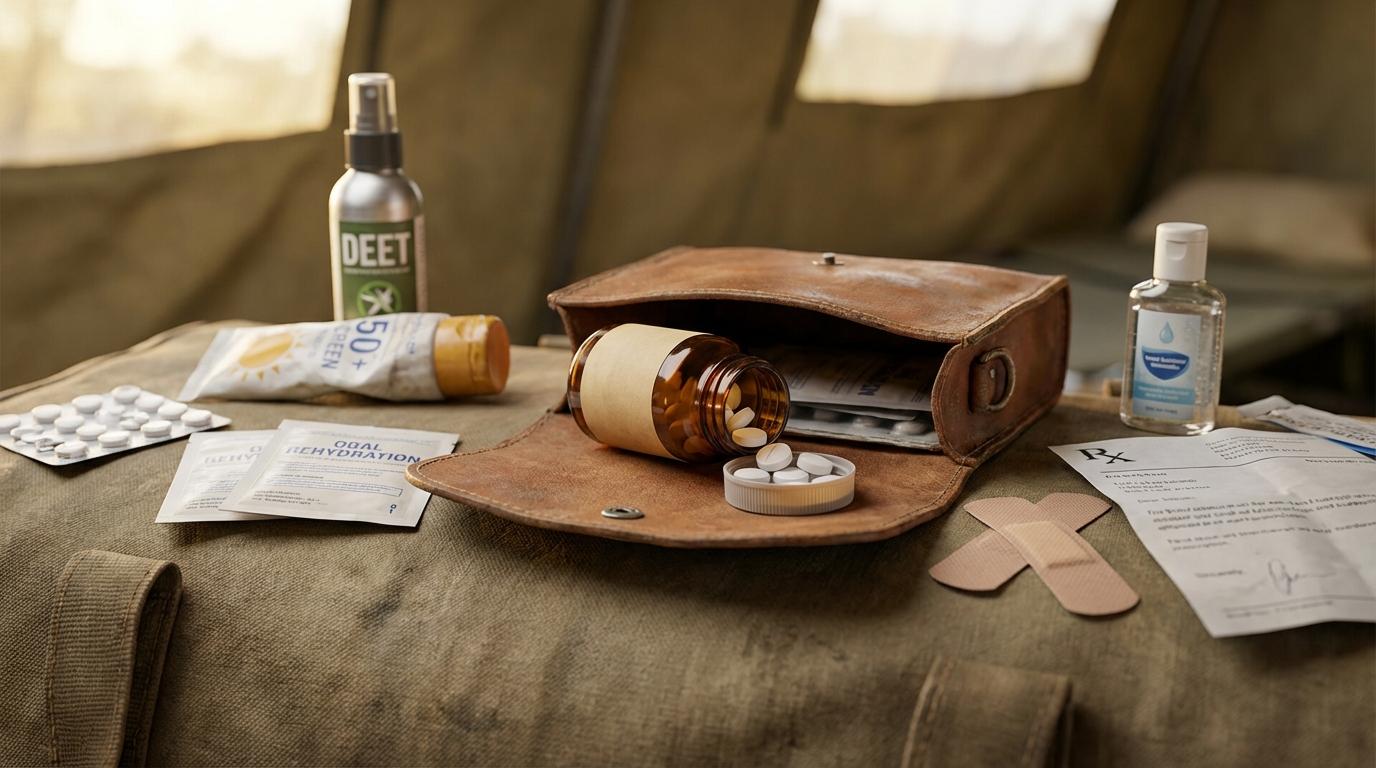
A good safari medical kit does not need to be huge. It does need to be thoughtful. Many travelers pack clothing and camera gear carefully, then throw health supplies into a bag at the last minute. It should be the other way around.
Build your kit around your itinerary, season, and personal health needs. Prescription medication should stay in original packaging, and it is wise to carry it in your hand luggage with a copy of the prescription.
Useful items often include:
- Prescription medications
- Malaria tablets
- Insect repellent
- Sunscreen
- Oral rehydration salts
- Anti-diarrheal medication
- Adhesive bandages
- Pain reliever
- Antihistamine
- Hand sanitizer
If you use contact lenses, bring more than you think you will need. If you have asthma, severe allergies, diabetes, or another ongoing condition, carry a written medical summary and any emergency medication where it is easy to reach.
Insurance is part of safari health planning
Vaccines and malaria tablets get most of the attention, but insurance belongs in the same conversation. Remote safari travel can involve long driving distances, light aircraft transfers, limited local medical facilities, and the possibility of evacuation to a larger hospital.
Africa Moja Tours requires travelers to carry travel insurance with meaningful protection, and that is a wise standard. A basic trip cancellation policy is not enough for a safari.
Look for coverage that includes the following:
- Emergency medical care: Treatment abroad, not just trip interruption
- Medical evacuation: Air or ground evacuation from remote areas if needed
- Repatriation: Transport home after serious illness or injury
- Trip cancellation or curtailment: Protection if illness affects your plans before or during travel
- Personal belongings: Useful for baggage delays, theft, or lost gear
Read the policy wording carefully. Some plans advertise evacuation cover, but the limits may be lower than you expect. Others have exclusions tied to pre-existing conditions unless you buy the plan within a certain window after your first trip payment.
If your itinerary includes gorilla trekking, walking safaris, rafting, or helicopter activities, check whether those count as adventure activities under the policy. That question is easy to miss until it matters.
On-the-ground support still matters
Good pre-trip planning is essential, but so is what happens once you arrive. One advantage of traveling with an experienced operator is that health and safety issues are not left entirely to chance.
Africa Moja Tours advises travelers on malaria risk before departure and arranges itineraries with guest safety in mind, including accommodations that commonly offer mosquito nets, screened windows, or similar protective features in relevant regions. Just as important, support is available during the trip if questions come up or plans need to shift.
That does not replace your clinic, your insurance, or your own preparation. It does mean you are not figuring things out alone if you feel sick, need local medical help, or need to coordinate the next step quickly.
A short checklist before you fly
The final week before departure is a good time to make sure nothing health-related has slipped through the cracks. A few minutes of checking now can save a lot of trouble later.
- Vaccines: Confirm what you received and carry proof if required
- Malaria plan: Pack enough medication for the full course, including after you return home
- Insurance documents: Save digital and printed copies with emergency contact numbers
- Clinic advice: Keep a note of any destination-specific instructions
- Hand luggage: Put essential medications and a small health kit in your carry-on
If you develop a fever during your safari, or after you get home, mention your travel history right away to a medical professional. Malaria can present after the trip, and early treatment matters.
A safari should feel exciting, not uncertain. When vaccines are sorted, malaria prevention is tailored to your route, and insurance is ready for real-world travel, you can focus on the reason you booked the trip in the first place: being present for those sunrise game drives, river crossings, big skies, and quiet moments in the bush.

