
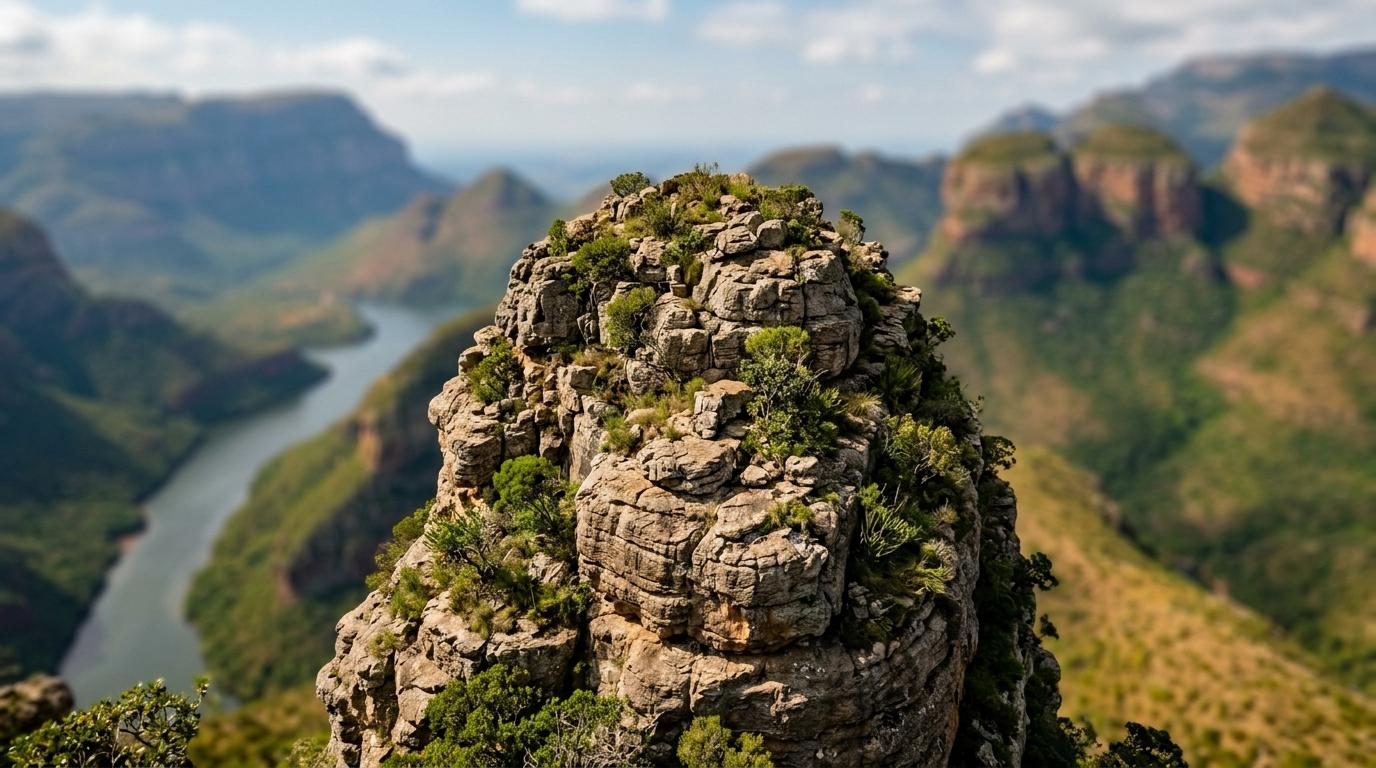
Few scenic drives in South Africa pack as much variety into a single day as the Panorama Route. In a matter of hours, the landscape shifts from forested escarpments and sheer lookouts to waterfalls, river-carved rock formations, and one of the country’s great natural landmarks, the Blyde River Canyon.
For many travelers, this route is the perfect counterpoint to a safari. After early game drives and long stretches scanning the bush, the Panorama Route offers wide views, cool mountain air, and dramatic stops that feel completely different from the lowveld below.
Why this route leaves such a strong impression
The Panorama Route runs through Mpumalanga’s escarpment region, an area known for high cliffs, deep valleys, and lush vegetation. It is easy to see why it has become one of the most popular day trips from Hazyview, White River, and the greater Kruger area. The drive is visually rich from start to finish, and the main attractions are close enough together to make a full-day outing realistic.
What makes it memorable is the contrast. One stop is all about distance and scale, where you look out across the lowveld toward the horizon. The next brings you close to pounding water or sculpted rock. Then the route opens again at the canyon, where the sheer size of the landscape can stop conversation for a moment.
Some travelers come for the canyon and remember the forest just as vividly.
Must-see stops at a glance
A well-planned day usually follows a simple flow: start with the escarpment viewpoints in the clear morning light, continue to the waterfalls and potholes, and finish at the canyon before lunch or the drive back. This order works well because weather and visibility often favor the earlier stops.
| Stop | Why it matters | Best timing | What to expect |
|---|---|---|---|
| God’s Window | One of the route’s signature views | Early morning | Cliff-edge lookout, indigenous forest, sweeping lowveld views |
| Lisbon Falls | Tall and photogenic waterfall | Mid-morning | Strong cascade, green ravine, viewing platform |
| Berlin Falls | Another classic waterfall stop | Mid-morning | Deep gorge, mist, easy photo stop |
| Bourke’s Luck Potholes | Unusual geological site | Late morning | Walkways, bridges, swirling pools, eroded sandstone |
| Blyde River Canyon and Three Rondavels | The showpiece of the route | Around midday | Vast canyon views, iconic rounded peaks, major photo stop |
| Graskop or Pilgrim’s Rest | Lunch and local character | Early afternoon | Restaurants, crafts, history, relaxed break |
If time is limited, God’s Window, Bourke’s Luck Potholes, and the Blyde River Canyon viewpoint are the big three. If you have a full day, adding the waterfalls and a lunch stop in Graskop rounds the experience out nicely.
God’s Window
God’s Window is often the first major stop, and that timing makes sense. Morning air is usually cooler and clearer, which can make a real difference when you are looking across a vast valley. On a clear day, the view stretches far over the lowveld, and many visitors are struck by how quickly the escarpment seems to drop away below their feet.
The site is more than a single viewpoint. There are short walking paths through indigenous forest, and that forest setting gives the stop a different mood from the open lookouts farther along the route. It can feel misty, shaded, and almost hidden until the view suddenly opens up.
This is one of those places where a photo rarely shows the full scale. The best approach is to take a few minutes, walk slowly, and let your eyes adjust to the distance. If cloud rolls in, wait a little. Conditions can change fast.
Waterfalls and rock formations that break up the drive beautifully
After the escarpment viewpoints, the route shifts into a series of shorter scenic stops. Lisbon Falls and Berlin Falls are close enough to combine easily, and both give you that classic Mpumalanga mix of water, cliffs, and dense greenery.
Lisbon Falls is often the more dramatic of the two at first glance, thanks to its height and strong vertical drop. Berlin Falls has its own charm, with a deep basin and a different shape to the gorge. If there has been good rain, both can be very impressive, and the sound of the water adds something that photos never capture.
Bourke’s Luck Potholes changes the rhythm of the day. Instead of standing still at a viewpoint, you walk bridges and paths over channels cut by the meeting of the Blyde and Treur Rivers. The potholes themselves are cylindrical rock formations created over many years by swirling water and sediment. Their patterns, colors, and curves make this one of the most unusual stops on the route.
It is also a good place to slow down and look closer. The canyon viewpoints are all about scale. The potholes are about texture, movement, and detail.
The canyon stop everyone waits for
Blyde River Canyon is the centerpiece of the Panorama Route, and it earns that reputation quickly. Often described as the third-largest canyon in the world and the largest green canyon on Earth, it combines vast size with dense vegetation, steep cliffs, and layered ridges that seem to keep unfolding into the distance.
The best-known viewpoint includes the Three Rondavels, three rounded mountain peaks that resemble traditional African huts. They rise above the canyon in a way that feels both dramatic and balanced, almost like a natural skyline. This is the stop where many visitors spend the longest time, partly because the view is so expansive and partly because there is something new to notice every few minutes as light and cloud shift across the rock faces.
Try to arrive with enough time to stand back from the railings, take the wide view in, and then move closer for details. You may notice the river far below, the changing greens on the canyon walls, and the distinct profiles of the peaks. Around midday, the light often works well here, especially when the sky is open.
Practical tips that make the day easier
The Panorama Route works well year-round, but each season gives it a different character. Winter, roughly May through August, is a favorite for clear skies and crisp views. Summer, usually November through March, brings fuller waterfalls, greener hillsides, and a more dramatic sense of abundance across the escarpment.
A full outing usually takes about eight to nine hours if you include transport, scenic stops, walking time, and lunch. That makes it very manageable as a day trip from Hazyview and nearby Kruger-area lodges. Families often enjoy it because the stops are varied, the walks are generally short, and the scenery changes often enough to keep the day interesting.
If you are planning what to bring, a few basics make a big difference:
- Comfortable shoes: many stops involve short walks, uneven paths, or stairs
- Light jacket: mornings on the escarpment can feel cool even in warmer months
- Sun protection: hat, sunscreen, and sunglasses still matter at higher viewpoints
- Camera or phone with space: you are likely to use it a lot
- Water bottle: helpful for a full day on the road
Road conditions and weather can affect timing, so a flexible mindset helps. Views may be crystal clear at one stop and misty at the next. That unpredictability is part of the route’s character.
Self-drive or guided tour?
A self-drive trip gives you freedom, especially if you like to linger at viewpoints or add extra stops. It can work very well for confident drivers who are already staying in the area and want to move at their own pace.
A guided day tour can be a very good choice if you want the route to feel easy from start to finish. Transport, timing, entrance logistics, and local context are handled for you, which leaves more room to enjoy the scenery. This option is especially appealing for first-time visitors, families, and travelers who are combining the route with a Kruger safari.
A guided option often suits travelers who want:
- Less driving and parking
- Local insight at each stop
- A set route with good timing
- Hotel pickup from Hazyview or nearby areas
If you are choosing between the two, think less about price alone and more about energy. After several days of safari activities, many people appreciate not having to manage the road themselves.
How to fit it into a wider South Africa trip
The Panorama Route is often paired with Kruger National Park or a private reserve stay, and that pairing works well because the experiences are so different. One day is about wildlife and patient observation. The next is about mountain roads, sweeping views, and geological landmarks.
It also fits neatly into a longer Mpumalanga stay. Travelers who base themselves in Hazyview are in a good position for both safari access and a day on the Panorama Route. Graskop can also work well if you want to be closer to the escarpment attractions, though many visitors prefer to keep safari accommodation separate from their scenic touring base.
If you are building a trip with a little variety, this route adds exactly that. It gives South Africa another shape, another color palette, and another sense of scale, all within easy reach of one of the country’s best-known safari regions.

